
Palio di Siena
Bareback horse racing and centuries-old rivalry in Siena’s central square
The Palio di Siena is a historic bareback horse race held twice yearly, on 2 July and 16 August, in Siena, Italy. Ten riders, each representing one of the city’s contrade or wards, compete around the Piazza del Campo in a tradition that dates back to the 17th century.
- Held twice yearly: 2 July and 16 August
- Ten contrade compete in each race
- Riders race bareback around Piazza del Campo
- The race lasts about 90 seconds and covers three laps
- A grand historical parade precedes the race
What it is
The Palio di Siena is a fiercely contested horse race that takes place in the heart of Siena, Italy. Each race sees ten of the city’s seventeen contrade—neighbourhoods with deep-rooted identities—compete for victory in the Piazza del Campo. The event is about much more than the race itself: it is a living tradition that stirs the city’s communal pride, rivalry, and devotion. For Sienese people, the Palio is a celebration of their history, their saints, and the bonds within each contrada. The race is the climax of days of ritual, pageantry, and anticipation, drawing locals and visitors alike into the city’s unique spirit.
Where it comes from
The Palio’s roots reach back to medieval times, when Siena’s central piazza hosted public games and contests. Early events included boxing matches, jousting, and even bullfights, but by the 16th century, races organized by the contrade had become popular. When bullfighting was banned in 1590, the focus shifted to races in the Piazza del Campo—first on buffalo and donkeys, then on horses. The first modern Palio, run in a circular route (palio alla tonda), was held in 1633. In 1729, the city’s governor formalized the boundaries of the contrade and set the rule that only ten could compete in each race, a tradition that continues today.
How it is celebrated
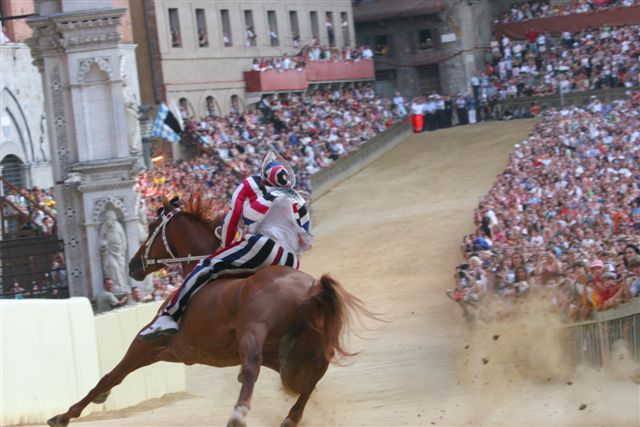
Celebrations for the Palio unfold over several days. Horses are selected and assigned to contrade by lottery, followed by trial races where riders and horses get to know the track. The city fills with pageantry: the Corteo Storico, a grand parade in medieval costume, winds through the streets, and flag-wavers perform to the sound of the March of the Palio. On race day, the Piazza del Campo is transformed with a thick layer of earth and padded barriers. Thousands gather in the square, and excitement builds as the carabinieri perform a ceremonial charge. The race itself is a dramatic, bareback dash for three laps around the piazza, lasting barely 90 seconds. The winner is the first horse—rider or not—to cross the finish line, and the victorious contrada celebrates with pride and ceremony.


Joining in
Visitors can join the spectacle by heading to Siena’s Piazza del Campo on 2 July or 16 August. The square fills early, and access is tightly controlled once festivities begin. While seats in bleachers or private boxes can be purchased, many choose to stand in the centre of the piazza, surrounded by the energy of the crowd. Expect a vibrant atmosphere, colourful banners, and the sound of drums and trumpets. The days leading up to the race are filled with rituals and parades, offering a chance to witness the city’s traditions up close. It’s wise to arrive early and be prepared for large crowds and intense local passion.
Sources and attribution
This page is Mela's own summary, written in new words. Its facts are drawn from the Wikipedia article Palio di Siena, whose text is available under the CC BY-SA 4.0 licence, and from its Wikidata record (CC0). Each photo is credited to its author beside it. For the full account, read the originals below.
Read more
- Palio di Siena on WikipediaEncyclopedia
- Official websiteOfficial site
- Encyclopaedia BritannicaArticle
- More photos on Wikimedia CommonsPhotos
- Wikidata recordOpen data
This page was written with AI assistance from the sources listed above, and checked automatically before publishing. Spotted a mistake? Tell us. Last refreshed 2026-10-02.
 Sports
 Arts and film
 Sports
 Sports
 Cultural
 Cultural
 Cultural
 Cultural