
Awa Dance Festival
Japan's largest dance festival, filling Tokushima's streets with music and movement
The Awa Dance Festival, or Awa Odori, is held each year from 12 to 15 August in Tokushima, Japan, as part of the Obon festival. Renowned as the largest dance festival in Japan, it draws hundreds of thousands of visitors to witness choreographed groups parade through the streets with music and vibrant costumes.
- Held annually from 12 to 15 August in Tokushima, Japan
- Features choreographed groups called ren parading through the streets
- Traditional music includes shamisen, taiko, flutes, and bells
- Men and women perform distinct dance styles in traditional costumes
- Spectators are often encouraged to join the dance
What it is
The Awa Dance Festival is a vibrant celebration in Tokushima, Shikoku, where groups of dancers and musicians, known as ren, fill the streets with movement and sound. It is held during Obon, a time when Japanese families honor the spirits of their ancestors. The festival is famous for its exuberant atmosphere, with participants wearing traditional costumes and performing unique, rhythmic dances to the accompaniment of shamisen, taiko drums, flutes, and bells. For locals, Awa Odori is a cherished tradition that brings the community together in joyful remembrance and lively expression.
Where it comes from
Awa Odori traces its roots to Buddhist priestly dances and lively harvest celebrations from the Kamakura period. Its connection to Obon, the Festival of the Dead, links it to rituals of honoring ancestors. The festival’s independent identity is popularly said to have begun in 1586, when a celebration at the opening of Tokushima Castle sparked spontaneous dancing and music. Historical records from the 17th century show that Awa’s bon-odori was already a major event, sometimes causing enough disruption to prompt official edicts. The name 'Awa Odori' became widely used in the 20th century, when the festival was revived as a symbol of Tokushima’s cultural heritage.
How it is celebrated
During the festival, choreographed groups parade through Tokushima’s streets, performing dances that differ by gender and age. Men’s dances are energetic, with crouched postures and sweeping arm movements, while women’s dances are more restrained and elegant, shaped by the kimono and geta sandals. Music is central: shamisen, taiko, flutes, and bells set the rhythm, and dancers chant or sing traditional songs like the Awa Yoshikono. Daytime performances are more measured, but at night the tempo quickens and the mood becomes exuberant. Spectators are often invited to join, and some groups feature acrobatic soloists in the kite dance. The festival’s call-and-response chants add to the communal spirit.


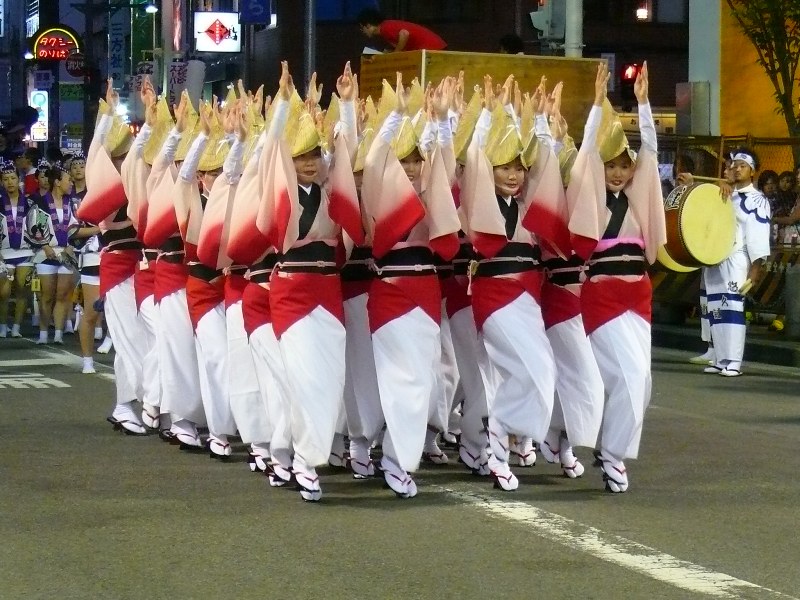

Joining in
Visitors to Tokushima during Awa Odori can expect the entire city to come alive with music and dance from 12 to 15 August. Main celebrations take place in the city center, where ticketed stands offer good views, but much of the action unfolds in the streets, open to all. It’s common for locals to encourage newcomers to join the dancing, so comfortable clothing and a willingness to participate are all you need. The festival is accessible and welcoming, offering a memorable experience of Japanese tradition and hospitality.
Sources and attribution
This page is Mela's own summary, written in new words. Its facts are drawn from the Wikipedia article Awa Dance Festival, whose text is available under the CC BY-SA 4.0 licence, and from its Wikidata record (CC0). Each photo is credited to its author beside it. For the full account, read the originals below.
Read more
- Awa Dance Festival on WikipediaEncyclopedia
- More photos on Wikimedia CommonsPhotos
- Wikidata recordOpen data
This page was written with AI assistance from the sources listed above, and checked automatically before publishing. Spotted a mistake? Tell us. Last refreshed 2026-10-02.
 Spiritual
 Spiritual
 Sports
 Cultural
 Cultural
 Cultural
 Cultural
 Cultural