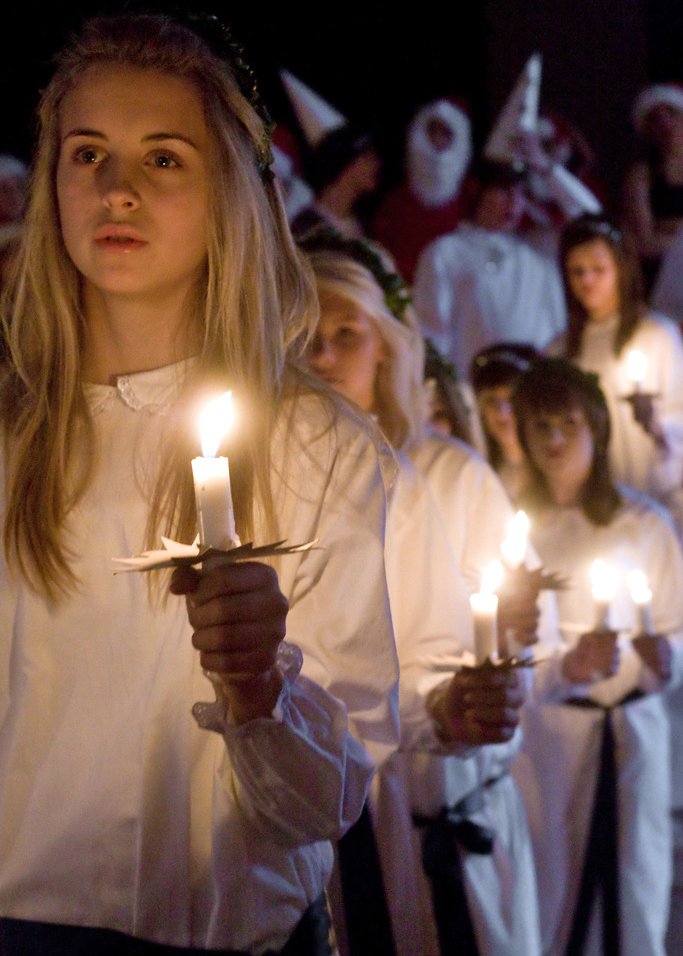
Saint Lucy's Day, or the Feast of Saint Lucy, is a Christian festival held on 13 December, especially celebrated in Sweden, Norway, and Finland. Marking the memory of Lucia of Syracuse, it brings processions of candle-lit singers, special foods, and rituals symbolizing light in the winter season.
- Girls in white dresses and candle crowns lead processions
- Saffron buns and cookies are shared during celebrations
- The festival marks the coming of light in winter darkness
- Observed on 13 December, during the Advent season
- Boys join as star boys, gingerbread men, or nisses
What it is
Saint Lucy's Day is a Christian feast that honors Lucia of Syracuse, a young martyr from the early fourth century. The festival is most widely observed in Scandinavia, where it has become a cherished symbol of light during the darkest time of the year. Traditionally, a girl dressed as Saint Lucy leads a procession, wearing a white robe with a red sash and a crown of candles, representing purity, martyrdom, and the bringing of light. The day is deeply meaningful for many, as it blends religious devotion with hopes for warmth, brightness, and the coming of Christmas.
Where it comes from
The origins of Saint Lucy's Day trace back to the fourth century in Syracuse, Sicily, where Lucy was venerated as a Christian martyr. Her feast became universal in the Church by the 6th century. The celebration spread to Scandinavia through Christian missionaries, where the story of a young girl bringing light resonated with people enduring long, dark winters. Some customs may predate Christianity, reflecting older traditions about the struggle between light and darkness. The festival's date, 13 December, once coincided with the winter solstice under the Julian calendar, reinforcing its association with light and renewal.
How it is celebrated
In Sweden, Norway, Denmark, and Finland, Saint Lucy's Day is marked by processions led by a girl portraying Lucia, dressed in white with a red sash and a candle-lit wreath on her head. She is often accompanied by other girls and boys in various roles, such as attendants, star boys, or gingerbread figures. The procession moves through homes, schools, churches, and public spaces, singing traditional songs that evoke the promise of light overcoming darkness. Saffron buns and cookies are shared, and the atmosphere is both solemn and joyful. In Italy and parts of Croatia and Hungary, other customs include planting wheat grains or holding special church services, each reflecting local interpretations of the story.


Joining in
Visitors in Sweden, Norway, or Finland can experience Saint Lucy's Day in cities and towns where processions are held in churches, schools, and public squares. Expect to see candle-lit ceremonies, hear choral singing, and taste seasonal treats like saffron buns. The mood is gentle and reflective, with a strong sense of community. While the festival is rooted in Christian tradition, its themes of light and hope are widely embraced, making newcomers welcome to observe or participate respectfully.
Sources and attribution
This page is Mela's own summary, written in new words. Its facts are drawn from the Wikipedia article Saint Lucy's Day, whose text is available under the CC BY-SA 4.0 licence, and from its Wikidata record (CC0). Each photo is credited to its author beside it. For the full account, read the originals below.
Read more
- Saint Lucy's Day on WikipediaEncyclopedia
- Encyclopaedia BritannicaArticle
- More photos on Wikimedia CommonsPhotos
- Wikidata recordOpen data
This page was written with AI assistance from the sources listed above, and checked automatically before publishing. Spotted a mistake? Tell us. Last refreshed 2026-10-02.
More from Finland
All festivals in Finland Spiritual
30Apr
Walpurgis Night🇨🇿 Czech Republic and 7 more countries
Spiritual
30Apr
Walpurgis Night🇨🇿 Czech Republic and 7 more countries
 Spiritual
29Nov
Feast of Christ the King🇦🇺 Australia and 7 more countriesIn 8 weeks
Spiritual
29Nov
Feast of Christ the King🇦🇺 Australia and 7 more countriesIn 8 weeks
 Cultural
27Nov
Buy Nothing Day🇨🇦 Canada and 8 more countriesIn 8 weeks
Cultural
27Nov
Buy Nothing Day🇨🇦 Canada and 8 more countriesIn 8 weeks
 National days
6Dec
Independence Day (Finland)🇫🇮 Helsinki, FinlandIn 9 weeks
National days
6Dec
Independence Day (Finland)🇫🇮 Helsinki, FinlandIn 9 weeks
 Spiritual
 Spiritual
 Spiritual
 Spiritual