Krakelingen and Tonnekensbrand
A centuries-old fire and bread festival marking winter's end in Geraardsbergen.
Krakelingen and Tonnekensbrand are ancient end-of-winter festivities held annually in Geraardsbergen, Belgium, on the last Sunday of February. The festival features a historic parade, the dramatic throwing of ring-shaped breads from Oudenberg hill, and a nighttime fire ritual symbolizing the return of light and life.
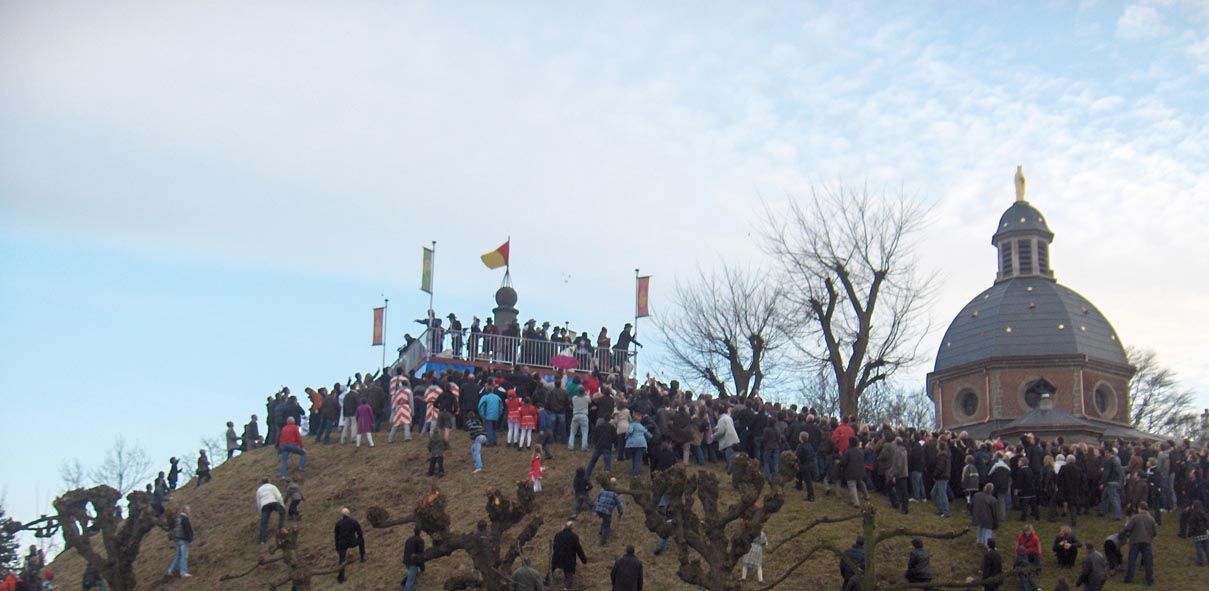
- Thousands of kringles are thrown from Oudenberg hill to the crowd.
- A live fish in wine is drunk by officials as part of the ritual.
- The Tonnekensbrand fire lights up the night to mark winter's end.
- A historic parade features locals in costume portraying 25 centuries of history.
- One kringle contains a note for a unique golden kringle jewel.
What it is
Krakelingen and Tonnekensbrand are twin festivals in Geraardsbergen, Belgium, celebrated as winter turns to spring. The day blends a vibrant historical procession, the unique ritual of throwing ring-shaped breads known as kringles, and an evening fire ceremony. Locals see the festival as a living link to both pre-Christian and Christian traditions, with symbols of bread, fire, and even live fish representing the cycles of life and renewal. For the people of Geraardsbergen, it is a proud expression of their heritage, community spirit, and the hope that comes with the return of longer days.
Where it comes from
The earliest record of Tonnekensbrand dates to 1393, though even then it was described as an old custom. The festival likely has roots in pre-Christian Celtic fire traditions, celebrating the end of winter and the coming of spring. Over centuries, Christian elements such as prayers led by the local dean were woven in. A local legend tells of townspeople throwing bread and herring over the city walls during a medieval siege to trick besiegers into believing the city was well-provisioned. While the historical truth is less romantic, the saga remains part of the festival’s storytelling.
How it is celebrated
Festivities begin with a grand historical parade through Geraardsbergen, featuring hundreds of locals in costume, reenacting scenes from the city’s past. The procession ends atop Oudenberg hill, where the dean and city officials perform a ritual that includes drinking wine with a live fish—a symbol of new life. Then, thousands of kringles (ring-shaped breads) are thrown into the crowd, with one containing a note for a special golden kringle jewel. After a pause for the city fair, the Tonnekensbrand fire ritual takes place at night: a straw figure is set alight on the hill, torches are distributed, and people carry the flames down to the city square, accompanied by folk dancing and lively fairground rides.

Joining in
Visitors to Geraardsbergen on the festival day can expect a full afternoon and evening of activity. The main events are centered on the Oudenberg hill and the city center, where crowds gather for the parade, the kringle throw, and the evening fire. The atmosphere is festive and communal, with locals eager to share their traditions. Arrive early for a good spot at the parade or the kringle throw, and be prepared for a lively, participatory experience that blends history, ritual, and celebration.
Sources and attribution
This page is Mela's own summary, written in new words. Its facts are drawn from the Wikipedia article Krakelingen and Tonnekensbrand, whose text is available under the CC BY-SA 4.0 licence, and from its Wikidata record (CC0). Each photo is credited to its author beside it. For the full account, read the originals below.
Read more
- Krakelingen and Tonnekensbrand on WikipediaEncyclopedia
- UNESCO Intangible Cultural HeritageArticle
- More photos on Wikimedia CommonsPhotos
- Wikidata recordOpen data
This page was written with AI assistance from the sources listed above, and checked automatically before publishing. Spotted a mistake? Tell us. Last refreshed 2026-10-02.
 Cultural
 Spiritual
 Music
Music Music
Music Cultural
 Cultural
 Cultural
 Cultural