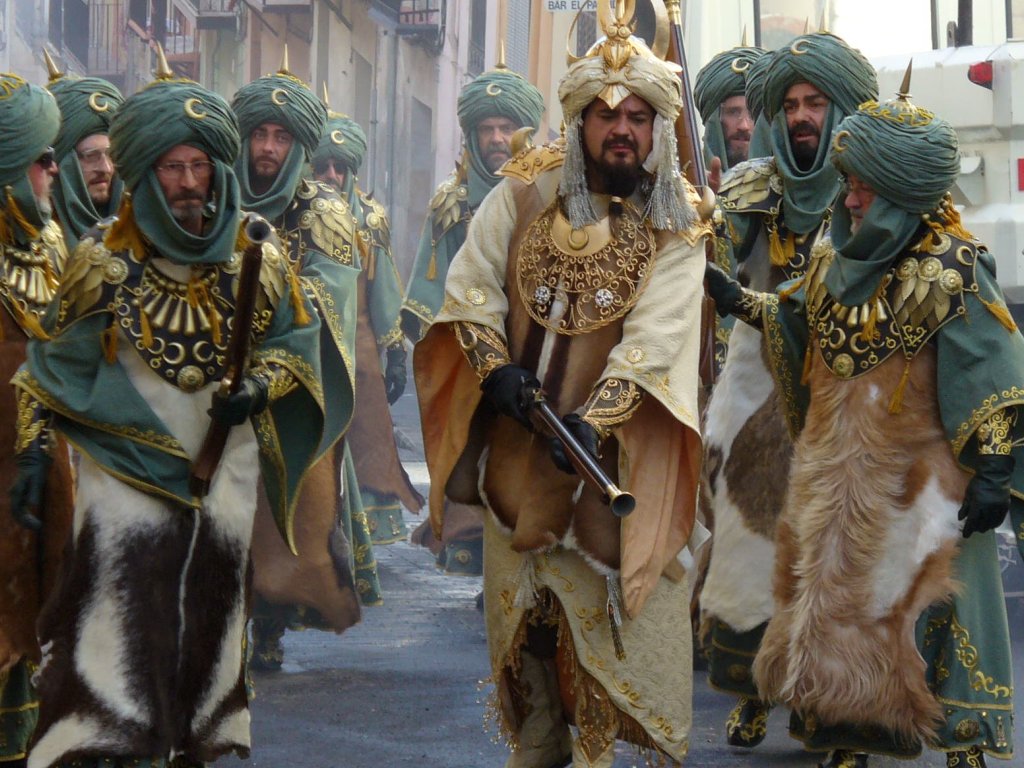
Moors and Christians of Alcoy
A vivid re-enactment of medieval battles and devotion in Alcoy, Spain
The Moors and Christians of Alcoy is a renowned festival held annually in Alcoy, Spain, commemorating the historic conflict between Muslims and Christians and honoring Saint George. Celebrated over several days in April, the festival features elaborate parades, mock battles, and religious processions that fill the city with color and tradition.
- Held annually in Alcoy, Spain, each April
- Features dramatic parades and mock battles
- Honors Saint George, Alcoy's patron
- Fourteen 'filaes' on each side represent Moors and Christians
- The Museu Alcoià de la Festa is dedicated to the festival
What it is
The Moors and Christians of Alcoy is a vibrant festival that brings history to life through dramatic re-enactments, parades, and ceremonies. Rooted in the memory of a medieval battle, it commemorates the legendary intervention of Saint George in defending Alcoy from a Muslim attack. Locals form troupes, or 'filaes', representing both Moorish and Christian sides, and the city transforms into a stage for pageantry, music, and storytelling. The festival is a source of deep pride for Alcoy, reflecting centuries of tradition and collective memory.
Where it comes from
The origins of the festival date back to the 13th century, when Saint George was credited with aiding the people of Alcoy during a Muslim uprising led by Al-Azraq in 1276. Over time, the commemoration evolved from a purely religious observance into a multi-day event, incorporating both sacred and secular elements. By the 16th century, the Town Hall began to include contests and public spectacles, and by the 18th century, the structure of the festival—with its parades, mock battles, and the appearance of Saint George—was largely established. The formation of 'filaes' or troupes further enriched the tradition.
How it is celebrated
Celebrations unfold over several days, each with its own character. The first day is marked by the 'Entradas', grand parades where the Moorish and Christian troupes march through Alcoy in elaborate costumes, accompanied by musicians and banners. The second day centers on religious observances, including processions with relics of Saint George, carried from Valencia Cathedral and accompanied by music and solemnity. The final day, known as the 'Alardo', features staged battles between the two sides, complete with an artificial castle, dramatic embassies, and the climactic appearance of Saint George atop the battlements. Throughout, the city is alive with music, color, and the camaraderie of the 'filaes', many of which have histories stretching back centuries.

Joining in
Visitors to Alcoy during the festival can expect a city transformed by spectacle and tradition. The main events take place in the heart of Alcoy, with parades winding through the streets and public squares filled with locals and guests alike. The Museu Alcoià de la Festa offers deeper insight into the festival's history and costumes. While the festivities are deeply rooted in local identity, newcomers are welcomed to watch the parades, enjoy the music, and witness the dramatic re-enactments that define this unique celebration.
Sources and attribution
This page is Mela's own summary, written in new words. Its facts are drawn from the Wikipedia article Moors and Christians of Alcoy, whose text is available under the CC BY-SA 4.0 licence, and from its Wikidata record (CC0). Each photo is credited to its author beside it. For the full account, read the originals below.
Read more
- Moors and Christians of Alcoy on WikipediaEncyclopedia
- More photos on Wikimedia CommonsPhotos
- Wikidata recordOpen data
This page was written with AI assistance from the sources listed above, and checked automatically before publishing. Spotted a mistake? Tell us. Last refreshed 2026-10-02.
 Spiritual
 Sports
 Cultural
 Spiritual
 Cultural
 Cultural
 Cultural
 Cultural