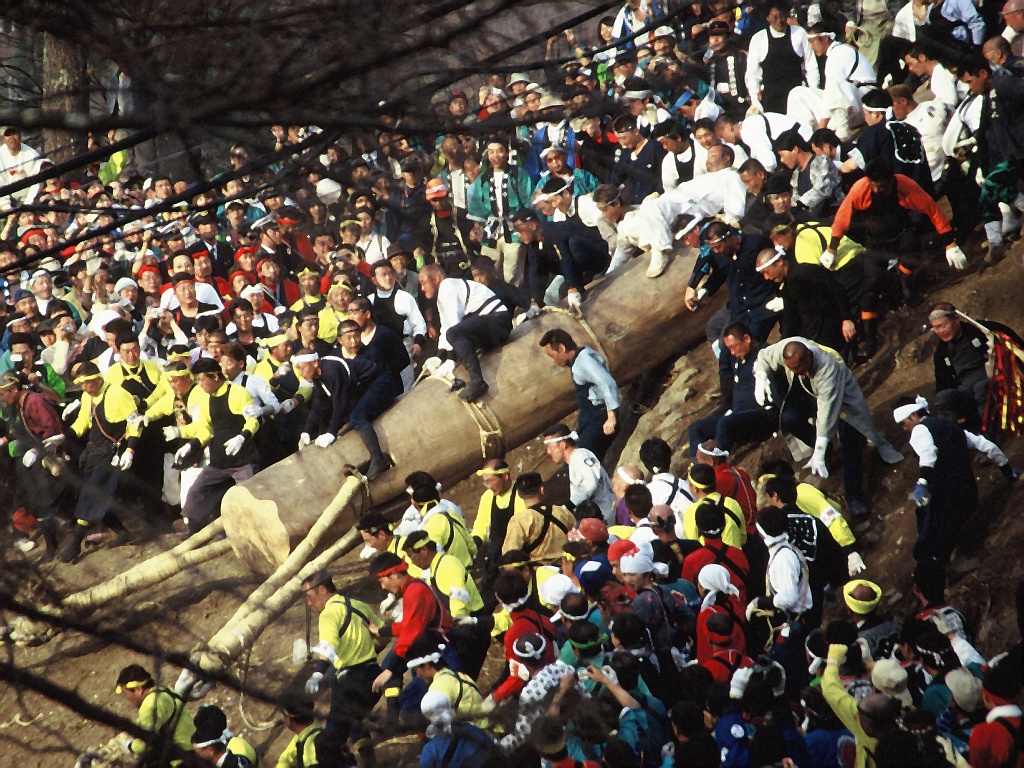
Onbashira Festival
Every six years, giant fir logs descend the mountains for Suwa's shrine renewal.
The Onbashira Festival is a dramatic Shinto event held every six years in the Lake Suwa area of Nagano Prefecture, Japan. Locals fell and transport massive fir logs down steep mountainsides to renew the sacred pillars of the Suwa Grand Shrine, in a tradition that spans over a millennium.
- Held every six years in Nagano’s Lake Suwa region
- Sixteen fir trees become shrine pillars
- Participants ride logs down steep mountainsides
- Festival dates back over 1,200 years
- Two main phases: Yamadashi and Satobiki
What it is
Onbashira Festival is a unique Shinto ritual centered on the renewal of the Suwa Grand Shrine’s sacred pillars. Every six years, communities around Lake Suwa in Nagano Prefecture unite to fell sixteen giant fir trees, which are then hauled from the mountains and erected at the four corners of the shrine complex. The event is not only a physical renewal of the shrine but also a spiritual act believed to invite divine protection and vitality. For locals, Onbashira is a profound expression of faith, tradition, and communal strength, with deep roots in the region’s identity.
Where it comes from
The origins of Onbashira are ancient and somewhat mysterious, with the festival believed to have been held for around 1,200 years. Historical records suggest the custom began in the late 8th or early 9th century, possibly during the reign of Emperor Kanmu. While the exact purpose of the pillars is debated, some scholars link them to prehistoric tree worship or as symbolic boundaries for sacred spaces. The festival’s timing and rituals also reflect influences from Chinese philosophy and the zodiac, aligning with years of the Monkey and Tiger.
How it is celebrated
Celebrations unfold in two main phases: Yamadashi and Satobiki. During Yamadashi, participants enter the mountains to select and fell the fir trees, then ride the massive logs as they are slid down steep slopes—a perilous and exhilarating tradition that has earned the festival a reputation for danger. The logs are then dragged through towns to the shrine. In Satobiki, the pillars are ceremoniously raised at the shrine’s corners, accompanied by communal chanting, traditional attire, and ritual music. The entire process is a display of collective effort, reverence, and excitement, with both solemn rituals and festive gatherings.


Joining in
Visitors can witness the main festivities in the towns surrounding Lake Suwa, including Suwa, Chino, Shimosuwa, Hara, Fujimi, and Okaya. Expect large crowds, vibrant processions, and the unforgettable sight of participants riding and hauling the giant logs. While the atmosphere is festive, safety is taken seriously due to the event’s inherent risks. Observers are welcomed to join the celebrations, watch the dramatic log rides, and experience the deep communal spirit that defines Onbashira.
Sources and attribution
This page is Mela's own summary, written in new words. Its facts are drawn from the Wikipedia article Onbashira, whose text is available under the CC BY-SA 4.0 licence, and from its Wikidata record (CC0). Each photo is credited to its author beside it. For the full account, read the originals below.
Read more
- Onbashira on WikipediaEncyclopedia
- Official websiteOfficial site
- More photos on Wikimedia CommonsPhotos
- Wikidata recordOpen data
This page was written with AI assistance from the sources listed above, and checked automatically before publishing. Spotted a mistake? Tell us. Last refreshed 2026-10-02.
 Cultural
 Spiritual
 Spiritual
 Sports
 Spiritual
 Spiritual
 Spiritual
 Spiritual