
Yalda Night
Families gather on the longest night to welcome the rebirth of the sun.
Yalda Night, also known as Shab-e Yalda or Chilla Night, is an ancient festival celebrated in Iran and neighboring regions on the winter solstice, usually December 21. Families and friends gather to eat, read poetry, and share the last fruits of summer, marking the longest night of the year and the return of longer days.
- Celebrated on the winter solstice, the longest night of the year
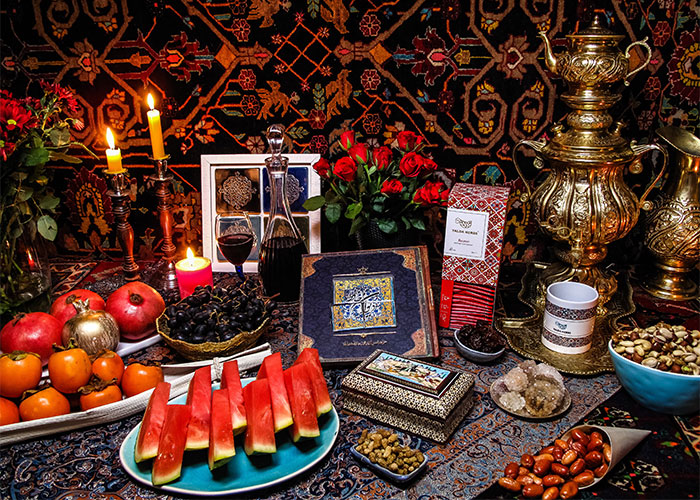
- Families gather to eat watermelon, pomegranate, and nuts
- Poetry readings from Hafez are a central tradition
- Recognized by UNESCO as Intangible Cultural Heritage
- Observed in Iran, Afghanistan, Tajikistan, Azerbaijan, and more
What it is
Yalda Night is a cherished celebration marking the winter solstice, the longest and darkest night of the year in Iran and several neighboring countries. It is a time when families and friends come together to share food, recite poetry—especially from the poet Hafez—and enjoy each other's company late into the night. The festival is seen as a symbol of the triumph of light over darkness, as from this night onward, days gradually become longer. The red fruits eaten, such as pomegranates and watermelons, are believed to represent the glow of dawn and the vitality of life.
Where it comes from
Yalda Night has deep roots in ancient Iranian culture, with its observance dating back to at least the Achaemenid Empire in the 6th century BCE. The festival originally had connections to solar rituals and the changing of seasons, reflecting the importance of sunlight and agricultural cycles to early societies. The name 'Yalda' comes from Syriac-speaking Christians, meaning 'birth', and was adopted into Persian as the festival became associated with the rebirth of the sun. Over centuries, the customs have adapted, but the core tradition of gathering to ward off the darkness remains strong.
How it is celebrated
On Yalda Night, extended families gather in homes, often around a korsi (a low table with a heater beneath and blankets draped over), to share a special meal and stay awake past midnight. A wide array of fruits and nuts are served, with watermelon and pomegranate taking center stage for their symbolic red color. Dried fruits, sweetmeats, and sometimes up to forty different edibles are enjoyed. Poetry readings, especially from the Divan-e Hafez, are a beloved part of the evening, with participants sometimes performing bibliomancy by opening the book at random for guidance. Light-hearted superstitions about the foods eaten and their protective qualities are also part of the tradition. The night is filled with warmth, laughter, and a sense of continuity with the past.


Joining in
If you visit Iran or regions with Iranian communities during Yalda Night, expect to be welcomed into homes filled with laughter, poetry, and the aroma of fresh fruit and nuts. The main celebrations take place in family settings rather than public spaces, but markets and bakeries bustle as people prepare. As a guest, you may be invited to join in reading poetry or sharing stories, and you will likely be offered slices of watermelon and pomegranate. The atmosphere is intimate and joyful, focused on togetherness and the anticipation of brighter days ahead.
Sources and attribution
This page is Mela's own summary, written in new words. Its facts are drawn from the Wikipedia article Yalda Night, whose text is available under the CC BY-SA 4.0 licence, and from its Wikidata record (CC0). Each photo is credited to its author beside it. For the full account, read the originals below.
Read more
- Yalda Night on WikipediaEncyclopedia
- UNESCO Intangible Cultural HeritageArticle
- More photos on Wikimedia CommonsPhotos
- Wikidata recordOpen data
This page was written with AI assistance from the sources listed above, and checked automatically before publishing. Spotted a mistake? Tell us. Last refreshed 2026-10-02.
 Spiritual
 Spiritual
 Sports
 Spiritual
 Seasonal
 Seasonal
 Seasonal
 Seasonal