
Palm Sunday is a Christian feast held on the Sunday before Easter, commemorating Jesus Christ’s entry into Jerusalem. Celebrated worldwide, it marks the start of Holy Week and is observed with processions, the blessing and distribution of palm branches, and special church services.
- Marks the start of Holy Week in Christianity
- Blessed palm branches are distributed in churches
- Processions often feature hymns and children carrying palms
- In colder climates, willow or olive branches are used instead of palms
- Palms are later burned for Ash Wednesday ashes in Western churches
What it is
Palm Sunday is the first day of Holy Week in Christianity, observed by churches across the world. It recalls the moment Jesus entered Jerusalem, greeted by crowds waving palm branches in honor. The day is rich with symbolism: the palms represent both peace and triumph, echoing the welcome given to Jesus as a peaceful king. For many Christians, Palm Sunday is a time to reflect on humility, hope, and the beginning of the journey toward Easter. The festival brings together communities in worship, processions, and the sharing of blessed branches, which are often kept at home as a sign of devotion.
Where it comes from
The origins of Palm Sunday are rooted in the accounts of the four canonical Gospels, which describe Jesus’ entry into Jerusalem a week before his resurrection. The crowd’s act of laying down palm branches was a gesture of honor, drawing from ancient Near Eastern and Jewish traditions, as well as Greco-Roman symbolism of victory. Over time, the event became a key part of the Christian liturgical calendar, marking the start of Holy Week. In different regions, local plants like willow or olive branches have been used when palms are unavailable, reflecting the adaptability of the tradition.
How it is celebrated
Celebrations of Palm Sunday vary by tradition and region, but most involve the blessing and distribution of palm branches (or local substitutes such as willow, olive, or box). In many churches, congregations gather for processions, sometimes circling the church or moving through the streets, carrying their branches and singing hymns. In Eastern Orthodox and Oriental churches, the day is marked with festive colors, special hymns, and the faithful holding both branches and candles. In some places, such as India, marigold flowers are also used to decorate the sanctuary. The blessed palms are often taken home and displayed near Christian art or kept in Bibles. In Western Christianity, these palms are later collected and burned to make ashes for the next year’s Ash Wednesday.
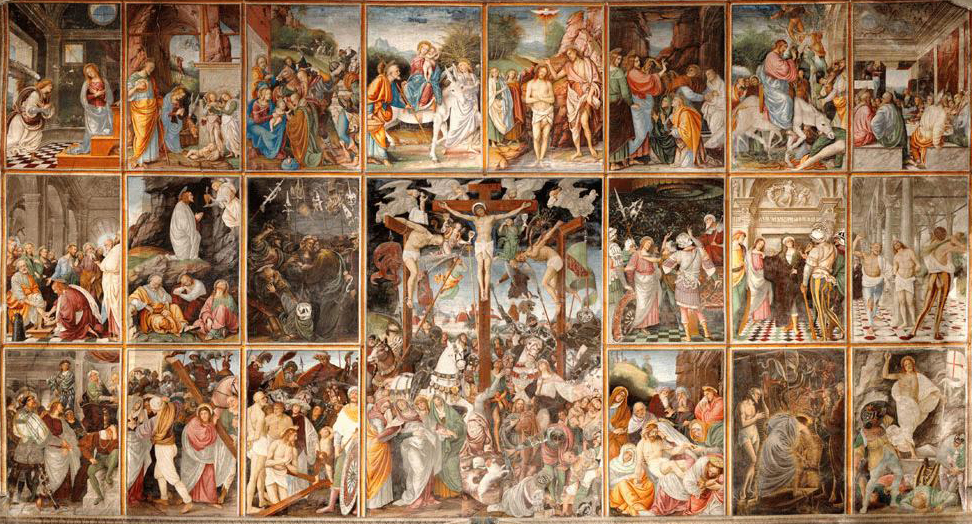


Joining in
Visitors are welcome to attend Palm Sunday services in churches around the world, from grand cathedrals in Europe to small village churches in India or Ethiopia. Expect to see processions, hear hymns, and receive a palm or local branch. In some regions, you may witness unique customs, such as the weaving of palm crosses or the use of local flowers. Participation is open to all, and the atmosphere is generally warm and communal, with a focus on reflection and anticipation of the coming Easter celebrations.
Sources and attribution
This page is Mela's own summary, written in new words. Its facts are drawn from the Wikipedia article Palm Sunday, whose text is available under the CC BY-SA 4.0 licence, and from its Wikidata record (CC0). Each photo is credited to its author beside it. For the full account, read the originals below.
Read more
- Palm Sunday on WikipediaEncyclopedia
- Encyclopaedia BritannicaArticle
- More photos on Wikimedia CommonsPhotos
- Wikidata recordOpen data
This page was written with AI assistance from the sources listed above, and checked automatically before publishing. Spotted a mistake? Tell us. Last refreshed 2026-10-02.
More spiritual festivals
See them all Spiritual
Marvaries
Easter🇦🇺 Australia and 29 more countries
Spiritual
Marvaries
Easter🇦🇺 Australia and 29 more countries
 Spiritual
9Mar
Eid al-Fitr🇦🇫 Afghanistan and 35 more countries
Spiritual
9Mar
Eid al-Fitr🇦🇫 Afghanistan and 35 more countries
 Spiritual
26Mar
Good Friday🇦🇷 Argentina and 42 more countries
Spiritual
26Mar
Good Friday🇦🇷 Argentina and 42 more countries
 Spiritual
21Mar
Holy Week🇧🇷 Brazil and 20 more countries
Spiritual
21Mar
Holy Week🇧🇷 Brazil and 20 more countries
 Spiritual
25Mar
Maundy Thursday🇦🇷 Argentina and 29 more countries
Spiritual
25Mar
Maundy Thursday🇦🇷 Argentina and 29 more countries
 Spiritual
Marvaries
Holi🇮🇳 India and 11 more countries
Spiritual
Marvaries
Holi🇮🇳 India and 11 more countries
 Spiritual
17Mar
Saint Patrick's Day🇦🇷 Argentina and 22 more countries
Spiritual
17Mar
Saint Patrick's Day🇦🇷 Argentina and 22 more countries
 Spiritual
25Mar
Feast of the Annunciation🇫🇷 France and 5 more countries
Spiritual
25Mar
Feast of the Annunciation🇫🇷 France and 5 more countries