
Purim is a Jewish festival that commemorates the deliverance of the Jewish people from a plot to destroy them, as told in the Book of Esther. Celebrated in Israel, Iran, and Jewish communities worldwide, it falls on the 14th of Adar in the Hebrew calendar, with Jerusalem and some ancient cities observing it on the 15th.
- Public reading of the Scroll of Esther in synagogues
- Exchanging gifts of food and drink (mishloach manot)
- Charity to the poor is a central tradition
- Costume parties and parades are common
- Special pastries called hamantashen are enjoyed
What it is
Purim is a vibrant Jewish holiday that marks the survival of the Jewish people in ancient Persia, as recounted in the Book of Esther. The story centers on Queen Esther and Mordecai, who thwarted Haman's plan to annihilate the Jews. For many, Purim is a time of joy, gratitude, and community, celebrating the reversal of fate and the power of courage and solidarity. It is a day when people come together to read the Megillah (Scroll of Esther), give to those in need, and share festive meals, embodying the themes of hope and resilience.
Where it comes from
The origins of Purim are rooted in the biblical Book of Esther, which tells of a plot by Haman, a high official in the Persian Empire, to destroy the Jews. Queen Esther and her cousin Mordecai intervened, leading to the salvation of their people. The festival's name comes from the word 'pur', meaning 'lot', referring to the lots Haman cast to choose the date of his plan. While the Book of Esther is traditionally seen as a historical account, modern scholarship often views it as a work of historical fiction with legendary elements. Purim has been celebrated annually since ancient times, with customs evolving across Jewish communities.
How it is celebrated
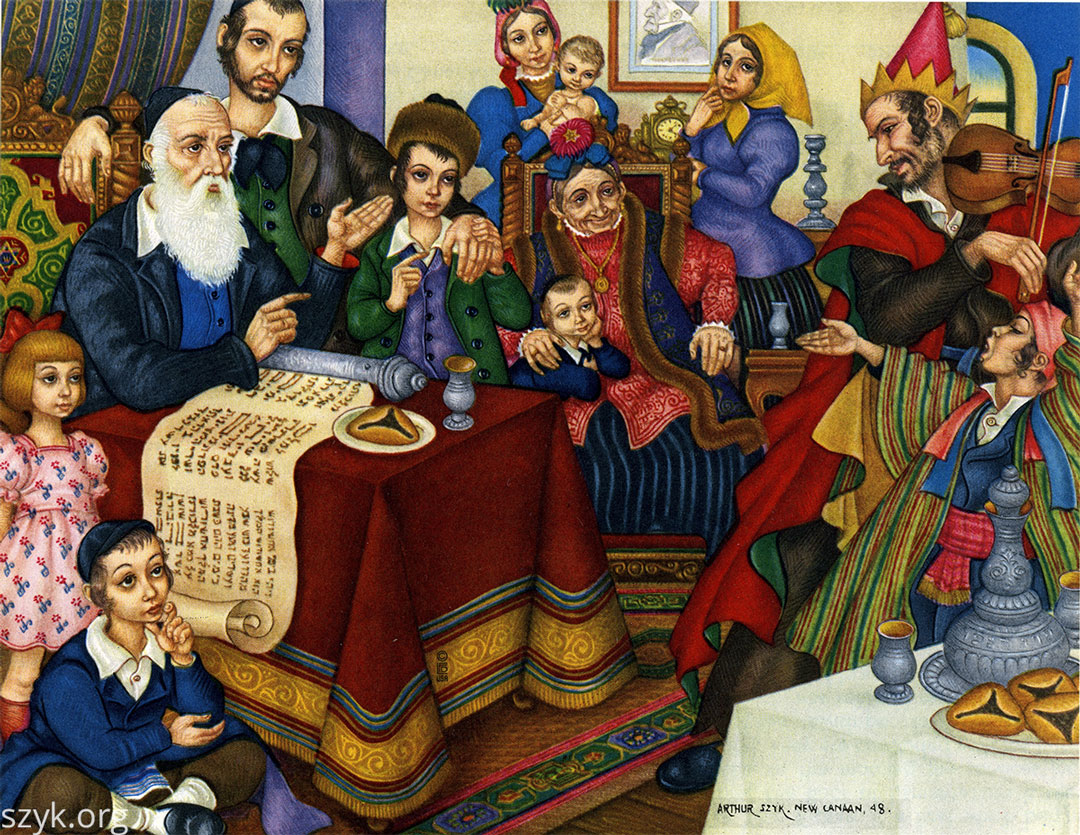
Purim is marked by a lively mix of religious and communal traditions. The day begins with the public reading of the Scroll of Esther in synagogues, where listeners often cheer the heroes and drown out Haman’s name with noise. Exchanging gifts of food and drink (mishloach manot) and giving charity to the poor (mattanot la-evyonim) are central acts, emphasizing generosity and care for others. Families and friends gather for a festive meal, often featuring wine and special pastries called hamantashen. Many dress in costumes and masks, and communities hold parades and parties, especially in Israel. In some Sephardic and Mizrahi communities, henna is applied as part of the celebration.


Joining in
Visitors can experience Purim in cities with vibrant Jewish life, such as Jerusalem, where the festival is observed on the 15th of Adar. Expect a joyful atmosphere with people in colorful costumes, street parades, and public readings of the Megillah. Synagogues welcome guests to join the storytelling and festivities. Sharing in the meal and exchanging small gifts or treats is a way to take part in the spirit of the day. In many places, the celebrations spill into the streets, making it easy for newcomers to join the fun and witness the sense of community and joy that defines Purim.
Sources and attribution
This page is Mela's own summary, written in new words. Its facts are drawn from the Wikipedia article Purim, whose text is available under the CC BY-SA 4.0 licence, and from its Wikidata record (CC0). Each photo is credited to its author beside it. For the full account, read the originals below.
Read more
- Purim on WikipediaEncyclopedia
- Encyclopaedia BritannicaArticle
- More photos on Wikimedia CommonsPhotos
- Wikidata recordOpen data
This page was written with AI assistance from the sources listed above, and checked automatically before publishing. Spotted a mistake? Tell us. Last refreshed 2026-10-02.
More spiritual festivals
See them all Spiritual
Marvaries
Easter🇦🇺 Australia and 29 more countries
Spiritual
Marvaries
Easter🇦🇺 Australia and 29 more countries
 Spiritual
9Mar
Eid al-Fitr🇦🇫 Afghanistan and 35 more countries
Spiritual
9Mar
Eid al-Fitr🇦🇫 Afghanistan and 35 more countries
 Spiritual
26Mar
Good Friday🇦🇷 Argentina and 42 more countries
Spiritual
26Mar
Good Friday🇦🇷 Argentina and 42 more countries
 Spiritual
21Mar
Palm Sunday🇦🇺 Australia and 27 more countries
Spiritual
21Mar
Palm Sunday🇦🇺 Australia and 27 more countries
 Spiritual
21Mar
Holy Week🇧🇷 Brazil and 20 more countries
Spiritual
21Mar
Holy Week🇧🇷 Brazil and 20 more countries
 Spiritual
25Mar
Maundy Thursday🇦🇷 Argentina and 29 more countries
Spiritual
25Mar
Maundy Thursday🇦🇷 Argentina and 29 more countries
 Spiritual
Marvaries
Holi🇮🇳 India and 11 more countries
Spiritual
Marvaries
Holi🇮🇳 India and 11 more countries
 Spiritual
17Mar
Saint Patrick's Day🇦🇷 Argentina and 22 more countries
Spiritual
17Mar
Saint Patrick's Day🇦🇷 Argentina and 22 more countries