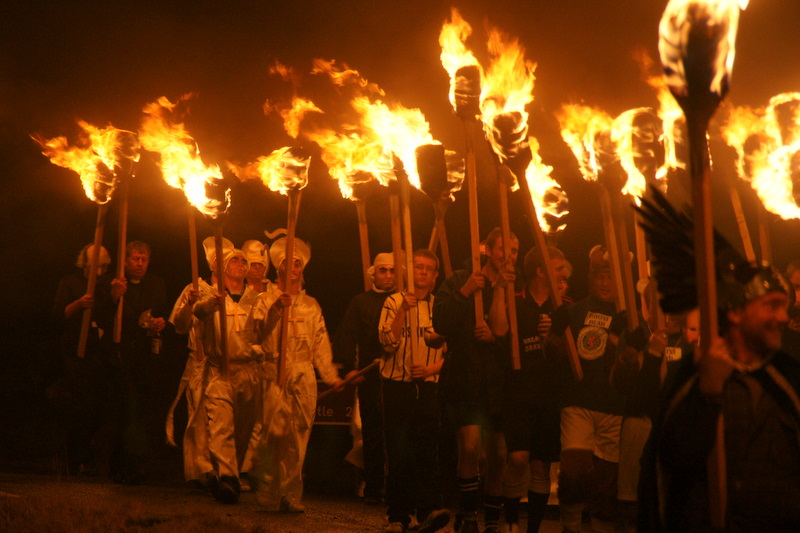
Up Helly Aa is a series of fire festivals held from January to March in communities across the Shetland Islands, Scotland, to mark the end of the Yule season. The largest celebration takes place in Lerwick on the last Tuesday of January, featuring torchlit processions and the burning of a replica Viking longship.
- Torchlit processions led by costumed 'guizers'
- Burning of a replica Viking longship
- Largest celebration in Lerwick on the last Tuesday of January
- Private parties and performances in local halls
- Women now participate in Lerwick's squads from 2023
What it is
Up Helly Aa is a vibrant fire festival celebrated in the Shetland Islands, Scotland, as a dramatic farewell to the Yule season. The festival is best known for its torchlit processions, where squads of costumed participants called guizers parade through the night streets, culminating in the burning of a replica Viking galley. The event is deeply rooted in Shetland’s community life and draws on the islands’ Norse heritage, blending spectacle and tradition. For locals, it is a time to come together, honour their history, and bring light to the dark winter months.
Where it comes from
The festival evolved from older Yule customs, particularly the raucous tradition of tar barrelling, where young men would drag burning barrels through town. After concerns about safety and drunkenness, the celebrations shifted in the late 19th century to torch processions inspired by Viking history. The first Up Helly Aa torch procession was held in 1881, and the burning of a replica longship was introduced in 1889. The festival’s name comes from the Lowland Scots 'Upholiday', meaning Twelfth Day, and was brought to Shetland in the 19th century. Over time, the event has grown and adapted, reflecting both Victorian influences and local Norse identity.
How it is celebrated
Celebrations begin with squads of guizers, often in elaborate costumes, gathering for a torchlit procession through the town. The main guizer, known as the Jarl, leads the march, and in Lerwick, up to a thousand participants may take part. The climax is the dramatic burning of a replica Viking galley, set alight by the torches. After the procession, squads visit local halls—schools, sports facilities, and hotels—where private parties are held. Each squad performs an act, which might be a humorous skit, a parody of popular culture, or a musical number. The festival has evolved to be more inclusive, with some rural celebrations now welcoming women, and Lerwick’s main festival lifting restrictions on women’s participation from 2023.


Joining in
Visitors to Shetland during Up Helly Aa can expect a lively, communal atmosphere, especially in Lerwick where the largest procession takes place on the last Tuesday of January. While the torchlit parade and galley burning are public spectacles, much of the post-procession celebration happens in private halls. Travellers are welcome to watch the outdoor events and soak up the festive spirit in the streets, but access to indoor parties is usually by invitation. Smaller festivals are held in other Shetland communities from January to March, each with its own local character.
Sources and attribution
This page is Mela's own summary, written in new words. Its facts are drawn from the Wikipedia article Up Helly Aa, whose text is available under the CC BY-SA 4.0 licence, and from its Wikidata record (CC0). Each photo is credited to its author beside it. For the full account, read the originals below.
Read more
- Up Helly Aa on WikipediaEncyclopedia
- Encyclopaedia BritannicaArticle
- More photos on Wikimedia CommonsPhotos
- Wikidata recordOpen data
This page was written with AI assistance from the sources listed above, and checked automatically before publishing. Spotted a mistake? Tell us. Last refreshed 2026-10-02.
 Sports
 Sports
 Spiritual
 Sports
 Cultural
 Cultural
 Cultural
 Cultural